Skip to Content
Exit

Author Archives: tmswebsiteadmin

  1. Demystifying Cold Rolled Steel Prices: Factors and Market Insights

    Comments Off on Demystifying Cold Rolled Steel Prices: Factors and Market Insights

    Navigating the current market for cold rolled steel necessitates a comprehensive analysis of various influencing factors, including supply chain disruptions and fluctuating demand. For businesses, a thorough understanding of these market dynamics is essential for making informed decisions and optimizing cost efficiency.

    Cold rolled steel costs are subject to ongoing fluctuations driven by various factors, ranging from manufacturing costs to global economic trends. This article explores recent market dynamics impacting cold rolled steel prices, focusing on manufacturing costs, supply-demand fluctuations, and global economic influences.

    1. Manufacturing Costs

    These are factors that influence manufacturing costs in the cold rolled steel industry:

    Raw Materials

    The prices of essential raw materials — such as iron ore and coking coal — vary widely. Events such as geopolitical tensions, natural disasters, or changes in production capacity can cause substantial price changes in these materials, directly affecting the cost of cold rolled steel.

    Energy

    The steel industry is heavily reliant on energy. Fluctuations in energy prices due to geopolitical events, policy changes, and shifts in supply and demand can cause substantial variations in production costs. As such, recent changes in natural gas and oil prices have particularly affected steel manufacturing.

    Labor

    Labor costs — influenced by wage trends, labor shortages, and inflation — also play a crucial role. Labor disputes or strikes in key steel-producing regions can disrupt production and increase prices.

    Technological Advancements

    Investments in advanced technologies can initially raise production costs, though they often lead to greater efficiency and cost savings over time. Current automation and smart manufacturing trends aim to improve processes and reduce waste.

    2. Supply and Demand Dynamics

    The following are factors influencing supply and demand dynamics in the cold rolled steel market:

    Global Steel Production

    Production levels in major steel-producing countries, notably China, significantly affect global supply. Policies to reduce pollution and production caps in these regions have recently tightened supply, leading to higher prices.

    Market Demand

    Economic recovery post-pandemic has surged demand in sectors such as construction and automotive. This increased demand, often outpacing supply, has driven cold rolled steel prices.

    Inventory Levels

    Inventory strategies among manufacturers and consumers affect price stability. Low inventory levels, particularly during high demand or supply chain disruptions, can lead to sharp price increases.

    Trade Policies

    Tariffs and trade restrictions influence the availability and cost of imported steel. For instance, US tariffs on steel imports have reduced the influx of cheaper foreign steel, causing domestic prices to rise.

    3. Global Economic Trends

    Listed below are the global economic trends impacting the cold rolled steel industry:

    Economic Growth

    The overall economic climate — reflected in GDP growth, inflation rates, and government fiscal policies — directly influences steel demand. During periods of robust economic growth, there is typically higher demand for steel across sectors like construction and manufacturing, which drives up prices.

    Currency Exchange Rates

    Fluctuations in currency values, such as a stronger US dollar, can impact the competitiveness of steel exports. When the dollar strengthens, US steel exports become more expensive for international buyers. This can reduce demand abroad and influence domestic prices as producers respond to market conditions.

    Inflation Rates

    Increasing inflation increases costs throughout the economy, including in steel production. As raw materials, energy, and labor prices rise, the cost of producing cold rolled steel increases — often passed on to customers through higher market prices.

    4. Market Speculation and Trends

    These are factors related to market dynamics and trends in the cold rolled steel sector:

    Futures Markets

    Activity in steel futures can result in considerable price changes. Traders’ predictions regarding projected supply and demand, influenced by current events and economic indicators, significantly impact price fluctuations.

    Industry Trends

    Emerging trends, such as the shift towards environmentally sustainable steel production and increased recycling efforts, are reshaping the industry. While these trends promote long-term sustainability goals, they can influence short-term production costs and market prices.

    Partner With Zeeco Metals for Reliable Steel Solutions!

    At Zeeco Metals, we understand the factors influencing cold rolled steel prices. Through our analysis of manufacturing costs, supply shifts, and economic trends that shape pricing, our company delivers affordable yet robust products you can depend on. We also offer a diverse range of high-quality steel products meticulously tailored to meet industry demands with reliability.

    Contact us today to explore our products and discover why industry leaders consistently choose us as their preferred partner for navigating dynamic steel prices!
  2. Hot Dipped Galvanized Steel: Exploring Its Advantages and Applications

    Comments Off on Hot Dipped Galvanized Steel: Exploring Its Advantages and Applications

    Hot dipped galvanized steel has been coated with a zinc layer through a process called hot dip galvanizing. This involves immersing the steel in molten zinc, which creates a protective layer on its surface. The coating helps prevent rust and corrosion, making the steel more durable and long-lasting. It also enhances the metal’s ability to withstand harsh environmental conditions.

    In this article, we will explore the benefits and applications of hot dipped galvanized steel, highlighting its suitability for specific industrial and outdoor environments.

    Benefits of Hot Dipped Galvanized Steel

    Here are the key benefits of utilizing hot dipped galvanized steel in different applications:

    Aesthetic Appeal

    The galvanized finish provides a clean appearance that can enhance the aesthetic appeal of structures. It also has a shiny, silvery look that can complement modern architectural designs and blend with various surroundings. This makes it a popular choice for visible components in construction projects.

    Corrosion Resistance

    The zinc coating corrodes preferentially to protect the underlying steel, preventing moisture, oxygen, and other corrosive agents from reaching the steel surface. This is especially crucial in environments prone to high humidity, salt exposure, or industrial pollutants.

    Cost-Effectiveness

    Although hot dipped galvanized steel may have a higher initial cost than non-coated steel, the long-term benefits outweigh the upfront investment. The reduced frequency of maintenance and lower risk of premature failure lead to significant savings over time.

    Durability

    The hot dip galvanizing process creates a robust coating that enhances the steel’s mechanical properties. The thickness and strength of the zinc coating ensure that the metal remains intact under heavy use and adverse conditions.

    Low Maintenance

    The coating effectively protects the metal from rust and corrosion, reducing the need for regular painting, inspections, or repairs. This low maintenance nature is advantageous for applications that are difficult to access or require frequent maintenance, as it saves time and labor costs.

    Industries Leveraging Hot Dipped Galvanized Steel

    Here are five industries that leverage this steel in their operations:

    Agriculture Industry

    The agriculture industry utilizes hot dipped galvanized steel for different applications, including livestock fencing, barn structures, and equipment frames. The coating protects the metal from the corrosive effects of moisture, manure, and chemicals commonly found in agricultural environments. This durability means that agricultural infrastructure remains functional and cost-effective over time.

    Construction Industry

    Hot dipped galvanized steel is widely used in construction for structural components such as beams, columns, and rebar. Its corrosion resistance makes it the preferred choice for indoor and outdoor applications, including exposed elements like railings and scaffolding. The durability of the hot dipped galvanized steel also helps ensure the longevity of buildings and infrastructure, which reduces maintenance costs and improves safety.

    Energy Sector

    This steel plays a crucial role in the energy sector, particularly in constructing utility poles, transmission towers, and pipeline supports. The steel’s resistance to harsh weather conditions makes it an ideal material for supporting energy infrastructure. Its longevity also helps maintain the reliability of energy distribution and transmission systems.

    Manufacturing Industry

    In manufacturing, hot dipped galvanized steel is used to produce machinery, equipment frames, and storage solutions. Its toughness and resistance to corrosion are extremely suitable for industrial settings where exposure to chemicals, moisture, and physical wear is common. Its durability also helps reduce maintenance costs and downtime associated with manufacturing equipment, ensuring smooth and efficient operations.

    Transportation Industry

    Hot dipped galvanized steel is used for components like bridges and guardrails in the transportation sector. The metal’s ability to withstand environmental stresses such as rain, snow, and road salt makes it suitable for these high-exposure applications. It is also used in railway tracks and signals, where its strength and resistance to wear and corrosion are crucial for safe operation.

    Choose Zeeco Metals for Superior Steel Solutions

    At Zeeco Metals, we offer premium-grade steel solutions for many applications. We also provide expert advice to help you select the best materials for your needs. Our commitment to exceptional client service and reliable delivery ensures that you receive the support and products you need to succeed.

    Contact us today to explore our products!

  3. Comparing Hot Rolled Steel Coils and Cold Rolled Steel Coils: A Comprehensive Analysis

    Comments Off on Comparing Hot Rolled Steel Coils and Cold Rolled Steel Coils: A Comprehensive Analysis

    Steel undergoes various processing methods to meet diverse industrial needs. Among these, hot and cold rolling are two primary techniques employed in producing steel coils. Understanding the differences between these methods and how they are processed is crucial for businesses in various sectors.

    This article discusses the technical aspects of hot rolled steel vs. cold rolled steel, focusing on the slitting process and how it influences material properties.

    Hot Rolled Steel vs. Cold Rolled Steel Coils

    Hot rolled steel is formed by heating steel slabs above their recrystallization temperature and shaping them into coils by rolling them. This results in a rougher surface texture and slightly variable thickness. These coils find applications in structural components, railroad tracks, and welding due to their lower cost and ease of forming.

    In contrast, cold rolled steel is produced at room temperature, creating coils with tighter dimensional tolerances and a wider range of surface finishes. It is preferred in industries where precise dimensions, surface quality, and mechanical properties are crucial, such as automotive and aerospace.

    The Slitting Process: Enhancing Steel Coil Properties

    Processing hot rolled steel vs. cold rolled steel coils involves several steps to transform raw steel into finished products suitable for various industrial applications. Among these, slitting is essential in transforming wide steel coils into narrower strips that meet specific width requirements. This process significantly influences the final properties of the steel, affecting hot rolled and cold rolled coils differently.

    1. Ensures Thickness Uniformity

    For hot rolled coils, slitting helps minimize thickness variations, which can be more pronounced due to the high-temperature cooling process. Cold rolled coils, already known for their uniform thickness, benefit from slitting by maintaining this consistency, ensuring precise dimensions for high-precision applications.

    2. Enhances Surface Quality

    Hot rolled steel coils have a rough, scaly surface due to rapid cooling post-rolling. Slitting can marginally smooth edges, improving suitability for less critical surface finish applications. Meanwhile, the already smooth surface finish of cold rolled steel coils is preserved, making them ideal for applications requiring a flawless appearance

    3. Reduces Residual Stresses

    Hot and cold rolling processes can introduce residual stresses into steel coils due to uneven cooling or deformation. Slitting can help alleviate these residual stresses by releasing tension along the length of the coil as it is cut into narrower strips. This can improve the dimensional stability and flatness of the steel strips, reducing the risk of warping or distortion during subsequent processing or usage.

    4. Improves Mechanical Properties

    Slitting can also influence the mechanical properties of steel coils. By controlling factors such as tension, speed, and blade geometry during the process, manufacturers can tailor the mechanical properties of coils to meet specific requirements.

    Experience Precision Steel Slitting at Its Finest With Zeeco Metals!

    At Zeeco Metals, we specialize in the precision slitting of hot and cold rolled steel coils. Our state-of-the-art equipment can handle various steel coil grades and thicknesses — from narrow slit coils as small as 0.5 inches to larger custom dimensions. We also work on other steel types, including galvanized, high-strength low-alloy (HSLA), and aluminized steel. With streamlined production processes and an optimized workflow, we meet your deadlines without compromising quality.

    Contact us today to learn how our services can meet your specific needs!

  4. Exploring the Distinctive Traits of Cold Rolled Steel Coils and Hot Rolled Steel Coils

    Comments Off on Exploring the Distinctive Traits of Cold Rolled Steel Coils and Hot Rolled Steel Coils
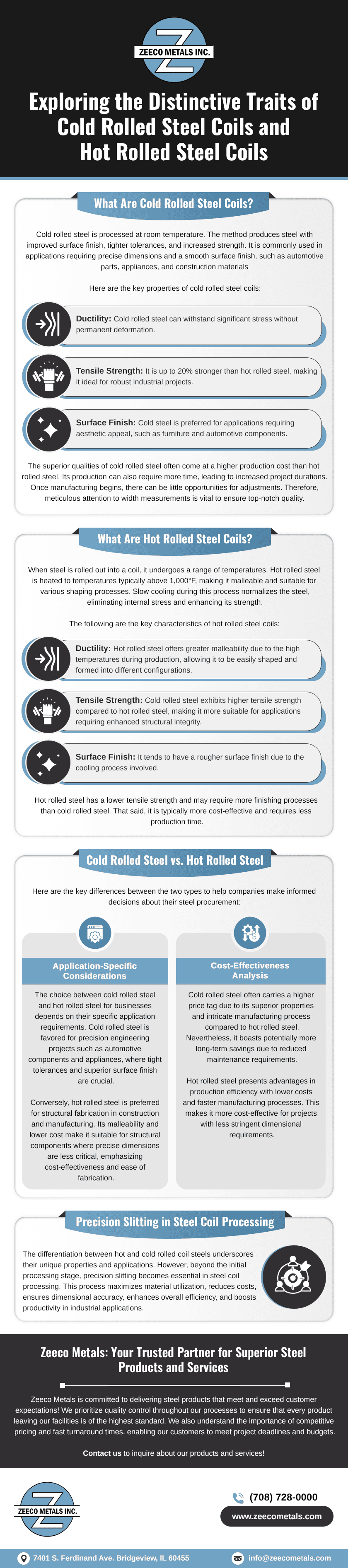
    Click to ExpandExploring the Distinctive Traits of Cold Rolled Steel Coils and Hot Rolled Steel Coils

    Rolled steel coils constitute foundational materials across different industries, from construction to automotive manufacturing. Their versatility manifests in their utilization across roofing sheets, building panels, pipes, reinforcing bars, and pivotal structural components such as beams and trusses. These rolled steels also provide the backbone for countless infrastructure projects worldwide.

    This article will highlight the key differences between cold rolled steel vs. hot rolled steel coils, outlining their characteristics and the precision slitting process.

    What Are Cold Rolled Steel Coils?

    Cold rolled steel is processed at room temperature. The method produces steel with improved surface finish, tighter tolerances, and increased strength. It is commonly used in applications requiring precise dimensions and a smooth surface finish, such as automotive parts, appliances, and construction materials

    Here are the key properties of cold rolled steel coils:

    • Ductility: Cold rolled steel can withstand significant stress without permanent deformation.
    • Tensile strength: It is up to 20% stronger than hot rolled steel, making it ideal for robust industrial projects.
    • Surface finish: Cold steel is preferred for applications requiring aesthetic appeal, such as furniture and automotive components.

    The superior qualities of cold rolled steel often come at a higher production cost than hot rolled steel. Its production can also require more time, leading to increased project durations. Once manufacturing begins, there can be little opportunities for adjustments. Therefore, meticulous attention to width measurements is vital to ensure top-notch quality.

    What Are Hot Rolled Steel Coils?

    When steel is rolled out into a coil, it undergoes a range of temperatures. Hot rolled steel is heated to temperatures typically above 1,000°F, making it malleable and suitable for various shaping processes. Slow cooling during this process normalizes the steel, eliminating internal stress and enhancing its strength.

    The following are the key characteristics of hot rolled steel coils:

    • Ductility: Hot rolled steel offers greater malleability due to the high temperatures during production, allowing it to be easily shaped and formed into different configurations.
    • Tensile strength: Cold rolled steel exhibits higher tensile strength compared to hot rolled steel, making it more suitable for applications requiring enhanced structural integrity.
    • Surface finish: It tends to have a rougher surface finish due to the cooling process involved.

    Hot rolled steel has a lower tensile strength and may require more finishing processes than cold rolled steel. That said, it is typically more cost-effective and requires less production time.

    Cold Rolled Steel vs. Hot Rolled Steel

    Here are the key differences between the two types to help companies make informed decisions about their steel procurement:

    Application-Specific Considerations

    The choice between cold rolled steel and hot rolled steel for businesses depends on their specific application requirements. Cold rolled steel is favored for precision engineering projects such as automotive components and appliances, where tight tolerances and superior surface finish are crucial.

    Conversely, hot rolled steel is preferred for structural fabrication in construction and manufacturing. Its malleability and lower cost make it suitable for structural components where precise dimensions are less critical, emphasizing cost-effectiveness and ease of fabrication.

    Cost-Effectiveness Analysis

    Cold rolled steel often carries a higher price tag due to its superior properties and intricate manufacturing process compared to hot rolled steel. Nevertheless, it boasts potentially more long-term savings due to reduced maintenance requirements.

    Hot rolled steel presents advantages in production efficiency with lower costs and faster manufacturing processes. This makes it more cost-effective for projects with less stringent dimensional requirements.

    Precision Slitting in Steel Coil Processing

    The differentiation between hot and cold rolled coil steels underscores their unique properties and applications. However, beyond the initial processing stage, precision slitting becomes essential in steel coil processing. This process maximizes material utilization, reduces costs, ensures dimensional accuracy, enhances overall efficiency, and boosts productivity in industrial applications.

    Partner With Zeeco Metals for Precision Slitting Excellence!

    Zeeco Metals’ expertise in precision slitting is instrumental in meeting the exacting demands of rolled steel coil processing across various industries. With a commitment to accuracy, efficiency, and customization, we ensure that our customers receive high-quality slit coils optimized for their specific applications.

    Contact us today to discuss your requirements for precision slit steel coils!

  5. Hot vs. Cold Rolled Steel Coils: Navigating the Best Choice for Your Needs

    Comments Off on Hot vs. Cold Rolled Steel Coils: Navigating the Best Choice for Your Needs
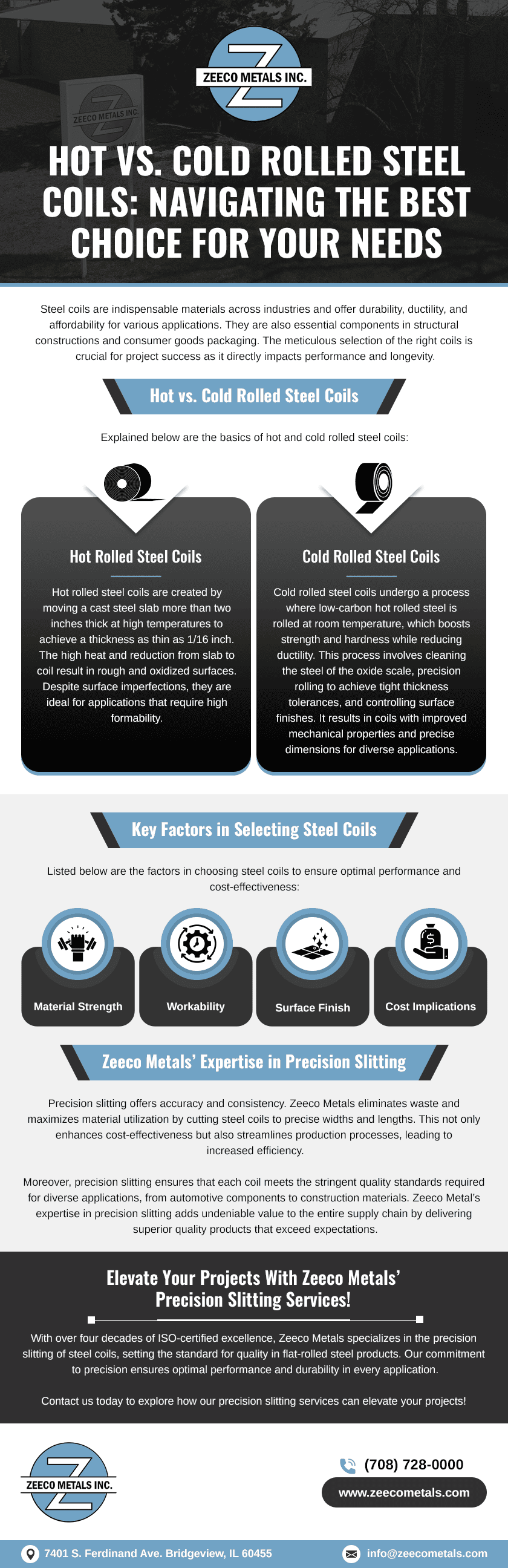
    Click to ExpandHot vs. Cold Rolled Steel Coils

    Steel coils are indispensable materials across industries and offer durability, ductility, and affordability for various applications. They are also essential components in structural constructions and consumer goods packaging. The meticulous selection of the right coils is crucial for project success as it directly impacts performance and longevity.

    This article explores the selection process for hot vs. cold rolled steel coils, highlighting the specialized services provided by Zeeco Metals.

    Hot vs. Cold Rolled Steel Coils

    Explained below are the basics of hot and cold rolled steel coils:

    Hot Rolled Steel Coils

    Hot rolled steel coils are created by moving a cast steel slab more than two inches thick at high temperatures to achieve a thickness as thin as 1/16 inch. The high heat and reduction from slab to coil result in rough and oxidized surfaces. Despite surface imperfections, they are ideal for applications that require high formability.

    Cold Rolled Steel Coils

    Cold rolled steel coils undergo a process where low-carbon hot rolled steel is rolled at room temperature, which boosts strength and hardness while reducing ductility. This process involves cleaning the steel of the oxide scale, precision rolling to achieve tight thickness tolerances, and controlling surface finishes. It results in coils with improved mechanical properties and precise dimensions for diverse applications.

    Key Factors in Selecting Steel Coils

    Listed below are the factors in choosing steel coils to ensure optimal performance and cost-effectiveness:

    Material Strength

    The strength of materials directly influences the performance and durability of products in different industries. Whether it is structural components or consumer goods packaging, the coil’s durability determines its suitability for specific project requirements. Cold rolled coils have better durability, while hot rolled steel is suitable for applications that require more formability.

    Workability

    Workability refers to the ease with which steel coils can be fabricated into desired shapes and forms. Different fabrication techniques require varying levels of formability, making it crucial to assess this aspect when selecting steel coils. Hot rolled steel coil’s exposure to high temperatures typically makes them more formable than cold rolled steel.

    Surface Finish

    The surface finish of steel coils plays a critical role in both aesthetics and functionality. A smooth, uniform surface enhances the final product’s appearance while improving its performance characteristics. Variances in the surface in hot vs. cold rolled steel coils influence the overall quality and performance of the product. Cold rolled steel coils have smoother surfaces because of the lack of heat treatment.

    Cost Implications

    Analyzing the costs of hot and cold rolled steel coils is essential for budget planning and resource allocation. While initial costs may vary, it is important to consider the long-term implications of each option. Conducting a cost-performance analysis enables engineers to strike a balance between technical specifications and budget constraints that ensures cost-effectiveness without compromising quality.

    Zeeco Metals’ Expertise in Precision Slitting

    Precision slitting offers accuracy and consistency. Zeeco Metals eliminates waste and maximizes material utilization by cutting steel coils to precise widths and lengths. This not only enhances cost-effectiveness but also streamlines production processes, leading to increased efficiency.

    Moreover, precision slitting ensures that each coil meets the stringent quality standards required for diverse applications, from automotive components to construction materials. Zeeco Metal’s expertise in precision slitting adds undeniable value to the entire supply chain by delivering superior quality products that exceed expectations.

    Elevate Your Projects With Zeeco Metals’ Precision Slitting Services!

    With over four decades of ISO-certified excellence, Zeeco Metals specializes in the precision slitting of steel coils, setting the standard for quality in flat-rolled steel products. Our commitment to precision ensures optimal performance and durability in every application.

    Contact us today to explore how our precision slitting services can elevate your projects!

  6. Galvanneal Steel Applications

    Comments Off on Galvanneal Steel Applications

    Galvanneal steel is a coated steel specially treated to improve corrosion resistance and paint adhesion. It is created through a two-step process involving galvanizing and annealing. First, the base steel undergoes a galvanizing process, where it is coated with a zinc layer. Then, it is subjected to an annealing procedure which heats the steel to a specific temperature before cooling it slowly.

    The galvanneal coating typically has a matte gray appearance, distinguishing it from regular galvanized steel with a bright, shiny surface. The coating thickness can differ based on the application and specific requirements, but it is generally thinner than a typical hot-dip galvanized surface.

    Here are examples of the most common applications of galvanneal steel:

    1. Automotive Parts

    Automotive chassis components — including frame rails, cross members, and underbody reinforcements — are often manufactured using galvanneal steel coils. These parts are subjected to severe conditions, including moisture, gravel, and road debris exposure. The galvanneal coating helps protect these components from corrosion and enhances their durability.

    Zeeco Metals offers galvannealed carbon steel specifically designed to manufacture automotive parts and components. It is a popular choice for OEM facilities engaged in stamping and roll forming processes, as it meets the specific requirements of these applications.

    2. Construction Projects

    Steel is well-suited for modular and prefabricated construction due to its strength, durability, and ease of assembly. Its galvanneal coating protects the component during transportation, installation, and throughout the building’s lifespan. This makes it popular in constructing modular buildings, prefabricated walls, and structural systems.

    Galvannealed carbon steel is particularly utilized to fabricate building components, including doors, window frames, and curtain wall systems. Its formability allows for intricate designs and precise manufacturing, ensuring seamless integration and functionality within the building envelope.

    3. HVAC Systems

    In HVAC systems, a galvanneal steel coil is often used for manufacturing air conditioning units, heat exchangers, ductwork, and other components. Its corrosion resistance helps prolong the HVAC equipment’s lifespan, especially in environments where moisture may be present. Additionally, the paint adhesion properties make applying a protective coating or a specific color to the components easier.

    4. Electrical Enclosures

    Junction boxes and other enclosures are used for electrical connections in various applications, including commercial and industrial settings. Galvannealed carbon steel is an excellent material for these containers because they offer superior corrosion resistance. This helps protect the electrical connections from moisture, dust, and corrosive substances.

    The galvanneal steel surface also acts as an extra layer of protection, shielding sensitive electronics from the corrosive agents present in the environment. This feature is crucial in chemical processing, oil and gas, and wastewater treatment plants.

    5. Agricultural Equipment

    Most agricultural machines and tools operate in demanding conditions and are exposed to chemical, soil, and water elements. The steel’s corrosion resistance and protective coating ensure that farm machinery remains durable and functional, even after prolonged exposure to these conditions. It is also beneficial in ensuring that grain bins and silos can withstand the rigors of long-term storage.

    Due to its durability, galvannealed carbon steel is also an excellent choice for agricultural fencing and livestock enclosures. Steel fences and plant barracks can endure the impacts of outdoor elements, such as wind, rain, and extreme temperatures.

    6. Road Signs and Traffic Structures

    Galvannealed carbon steel is extensively used in manufacturing road signs, traffic signal poles, guardrails, and other transportation infrastructure projects. It allows them to thrive in harsh weather, road salt, and environmental toxic substances. It also guarantees that road signs are visible, structurally solid, and safe for long periods.

    Choose Zeeco Metals Galvanneal and Electrogalvanized Steel Solutions

    Zeeco Metals is a trusted supplier of top-notch electrogalvanized steel coils! Our extensive inventory of products caters to a wide range of needs, offering various gauges to suit different applications. Whether you need steel for automotive components, construction materials, or other tasks, we have the right steel grades to fulfill your needs.

    Contact us today to discuss your project needs! You can also browse our product catalog to learn more about our extensive selection of galvannealed carbon steel.

  7. Hot Rolled Pickled and Oiled Steel Uses

    Comments Off on Hot Rolled Pickled and Oiled Steel Uses
    Click to ExpandHot-Rolled-Pickled-and-Oiled-Steel-Uses

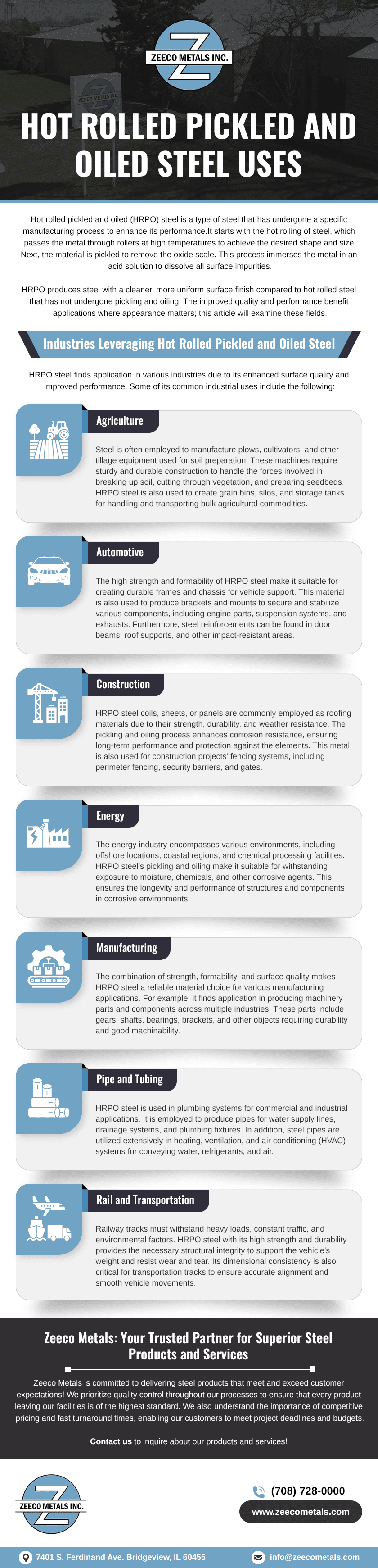
    Hot rolled pickled and oiled (HRPO) steel is a type of steel that has undergone a specific manufacturing process to enhance its performance.It starts with the hot rolling of steel, which passes the metal through rollers at high temperatures to achieve the desired shape and size. Next, the material is pickled to remove the oxide scale. This process immerses the metal in an acid solution to dissolve all surface impurities.

    HRPO produces steel with a cleaner, more uniform surface finish compared to hot rolled steel that has not undergone pickling and oiling. The improved quality and performance benefit applications where appearance matters; this article will examine these fields.

    Industries Leveraging Hot Rolled Pickled and Oiled Steel

    HRPO steel finds application in various industries due to its enhanced surface quality and improved performance. Some of its common industrial uses include the following:

    Agriculture

    Steel is often employed to manufacture plows, cultivators, and other tillage equipment used for soil preparation. These machines require sturdy and durable construction to handle the forces involved in breaking up soil, cutting through vegetation, and preparing seedbeds. HRPO steel is also used to create grain bins, silos, and storage tanks for handling and transporting bulk agricultural commodities.

    Automotive

    The high strength and formability of HRPO steel make it suitable for creating durable frames and chassis for vehicle support. This material is also used to produce brackets and mounts to secure and stabilize various components, including engine parts, suspension systems, and exhausts. Furthermore, steel reinforcements can be found in door beams, roof supports, and other impact-resistant areas.

    Construction

    HRPO steel coils, sheets, or panels are commonly employed as roofing materials due to their strength, durability, and weather resistance. The pickling and oiling process enhances corrosion resistance, ensuring long-term performance and protection against the elements. This metal is also used for construction projects’ fencing systems, including perimeter fencing, security barriers, and gates.

    Energy

    The energy industry encompasses various environments, including offshore locations, coastal regions, and chemical processing facilities. HRPO steel’s pickling and oiling make it suitable for withstanding exposure to moisture, chemicals, and other corrosive agents. This ensures the longevity and performance of structures and components in corrosive environments.

    Manufacturing

    The combination of strength, formability, and surface quality makes HRPO steel a reliable material choice for various manufacturing applications. For example, it finds application in producing machinery parts and components across multiple industries. These parts include gears, shafts, bearings, brackets, and other objects requiring durability and good machinability.

    Pipe and Tubing

    HRPO steel is used in plumbing systems for commercial and industrial applications. It is employed to produce pipes for water supply lines, drainage systems, and plumbing fixtures. In addition, steel pipes are utilized extensively in heating, ventilation, and air conditioning (HVAC) systems for conveying water, refrigerants, and air.

    Rail and Transportation

    Railway tracks must withstand heavy loads, constant traffic, and environmental factors. HRPO steel with its high strength and durability provides the necessary structural integrity to support the vehicle’s weight and resist wear and tear. Its dimensional consistency is also critical for transportation tracks to ensure accurate alignment and smooth vehicle movements.

    Zeeco Metals: Your Trusted Partner for Superior Steel Products and Services

    Zeeco Metals is committed to delivering steel products that meet and exceed customer expectations! We prioritize quality control throughout our processes to ensure that every product leaving our facilities is of the highest standard. We also understand the importance of competitive pricing and fast turnaround times, enabling our customers to meet project deadlines and budgets.

    Contact us to inquire about our products and services!

  8. Corporate Memberships

    Comments Off on Corporate Memberships

    Corporate memberships serve as a gateway in the metal manufacturing industry to connect with industry peers, gain access to resources, and engage in collaborations. Companies and businesses can enhance their operations through these memberships and remain competitive in the marketplace. They also provide opportunities for professional development and training to acquire new skills and knowledge.

    Zeeco Metals has successfully leveraged corporate memberships to enhance operations and remain competitive. With nearly five decades of experience, we have built a reputation for providing high-quality slit steel coils in various grades/gauges/widths. Thanks to our memberships, we have been able to stay informed and up-to-date with the latest trends and technologies.

    This blog post will explore the various corporate memberships Zeeco Metals is a part of. We will also examine how they contribute to the company’s growth and success.

    Top Industry Associations of Zeeco Metals

    For companies like Zeeco Metals, being a part of top industry associations can provide various benefits. These include accessing valuable industry insights, market data, and best practices to help businesses stay informed and relevant. Here are three associations that we are proud to be a part of:

    Association of Metals, Processors, and Distributors (AMPD)

    AMPD is an affiliate association for FMA.  This organization serves as an integral part of FMA in supporting and promoting metal processing and distribution of steel products through training programs, educational conferences, exhibitions, publications, fund raising, amongst other activities.

    Through AMPD members can stay abreast of the latest developments in the metals industry in order to foster a better understanding of the roles of metals distributors, mills, processors, and their respective end users.  AMPD promotes ethical business practices and standards within the metals industry, allowing members to share knowledge and expertise of their respective part in the industry.

    Fabricators and Manufacturers Association, International (FMA)

    FMA is a professional organization that represents the metal fabrication industry. It serves a wide range of professionals, including fabricators, manufacturers, and suppliers of metal parts and components. The association also brings together metal fabrication experts to collectively advance the industry. This is done through industry-exclusive networking events, trade shows, and valuable training programs.

    In addition to uniting and supporting established professionals, FMA invests in the industry’s future by encouraging students to pursue manufacturing careers. The association offers camps and scholarship programs to help develop some of the sector’s brightest minds. By doing so, FMA actively shapes the future of metal fabrication and assures the industry’s continued growth and evolution.

    Association of Women in the Metal Industries (AWMI)

    The AWMI is a professional organization founded in California to foster the growth of women in the metal industries. Since its founding, AWMI had expanded to have chapters all across the United States. The association recognizes that women can benefit themselves and their companies by forming relationships, sharing knowledge, and engaging in education. Its programs and activities aim to improve members’ skills and experiences, tackle industry challenges, and promote career growth.

    The group conducts annual conferences featuring industry speakers and tours blending professional and personal development in an informative and engaging way. This accessible learning environment helps individuals achieve their full potential and contribute to the growth of the metal industries. Additionally, membership is open to men and women seeking to develop their skills and advance their careers.

    Partner With Zeeco Metals for Guaranteed Products and Services

    Zeeco Metals has been a leading provider of flat-rolled carbon steel products for almost half a century! We take pride in delivering top-notch slit steel coils at competitive prices with fast turnaround times. Our expertise lies in various flat-rolled low carbon steels, including hot rolled pickled and oiled, cold rolled, hot dip galvanized, galvannealed, electrogalvanized, and aluminized.

    Contact us to inquire about our products and services or request a quote! We would happily assist you with your needs.

  9. Key Considerations With Hot Dipped Galvanized Steel

    Comments Off on Key Considerations With Hot Dipped Galvanized Steel
    Click to ExpandKey-Considerations-With-Hot-Dipped-Galvanized-Steel

    Hot dipped galvanized steel is popular for applications that are in harsh environments due to its durability and corrosion resistance. It is produced by subjecting a hot-rolled pickled and oil or cold rolled coil to a hot zinc bath. This provides the steel with a coating that increases durability with regards to rusting and other forms of degradation.

    Zeeco Metals slits hot dipped galvanized steel coils by feeding a master coil through sharp circular blades on our slitter head to slit the coil into narrower widths that our customers then use to create their desired part. This post will explore the process of creating hot dipped galvanized steel.

    The Process of Hot Dip Galvanizing

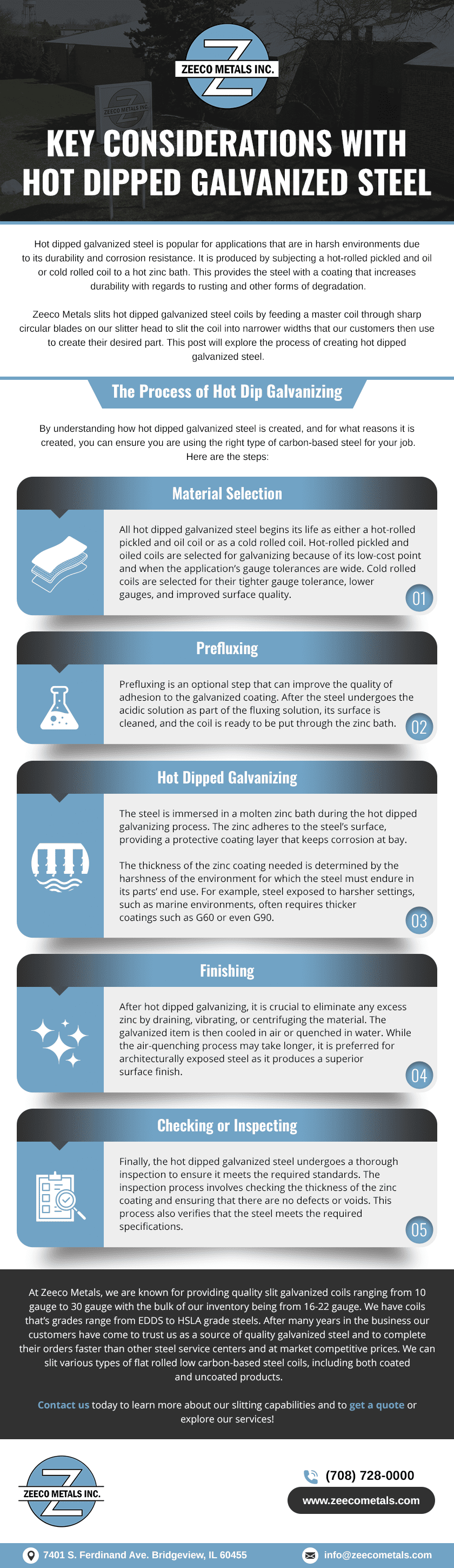
    By understanding how hot dipped galvanized steel is created, and for what reasons it is created, you can ensure you are using the right type of carbon-based steel for your job. Here are the steps:

    1. Material Selection

    All hot dipped galvanized steel begins its life as either a hot-rolled pickled and oil coil or as a cold rolled coil. Hot-rolled pickled and oiled coils are selected for galvanizing because of its low-cost point and when the application’s gauge tolerances are wide. Cold rolled coils are selected for their tighter gauge tolerance, lower gauges, and improved surface quality.

    2. Prefluxing

    Prefluxing is an optional step that can improve the quality of adhesion to the galvanized coating. After the steel undergoes the acidic solution as part of the fluxing solution, its surface is cleaned, and the coil is ready to be put through the zinc bath.

    3. Hot Dipped Galvanizing

    The steel is immersed in a molten zinc bath during the hot dipped galvanizing process. The zinc adheres to the steel’s surface, providing a protective coating layer that keeps corrosion at bay.

    The thickness of the zinc coating needed is determined by the harshness of the environment for which the steel must endure in its parts’ end use. For example, steel exposed to harsher settings, such as marine environments, often requires thicker coatings such as G60 or even G90.

    4. Finishing

    After hot dipped galvanizing, it is crucial to eliminate any excess zinc by draining, vibrating, or centrifuging the material. The galvanized item is then cooled in air or quenched in water. While the air-quenching process may take longer, it is preferred for architecturally exposed steel as it produces a superior surface finish.

    5. Checking or Inspecting

    Finally, the hot dipped galvanized steel undergoes a thorough inspection to ensure it meets the required standards. The inspection process involves checking the thickness of the zinc coating and ensuring that there are no defects or voids. This process also verifies that the steel meets the required specifications.

    Zeeco Metals: Your Trusted Partner for Precision Slitting of Hot Dipped Galvanized Steel!

    At Zeeco Metals, we are known for providing quality slit galvanized coils ranging from 10 gauge to 30 gauge with the bulk of our inventory being from 16-22 gauge. We have coils that’s grades range from EDDS to HSLA grade steels. After many years in the business our customers have come to trust us as a source of quality galvanized steel and to complete their orders faster than other steel service centers and at market competitive prices. We can slit various types of flat rolled low carbon-based steel coils, including both coated and uncoated products.

    Contact us today to learn more about our slitting capabilities and to get a quote or explore our services!

  10. Electro-Galvanized Steel Benefits

    Comments Off on Electro-Galvanized Steel Benefits
    Click to ExpandElectro-Galvanized-Steel-Benefits

    Electro-galvanization is a widespread technique that applies a thin zinc layer onto steel to protect it against corrosion. It varies from the conventional galvanization approach as it deploys an electric current to bond the zinc onto the steel surface. This generates a more consistent and accurate coating. It is extensively utilized in various industries, including the automotive, construction, and electrical sectors.

    This article will explore how electro-galvanization works and highlight the benefits of using electro-galvanized steel to produce durable and reliable components.

    The Electro-Galvanization Process

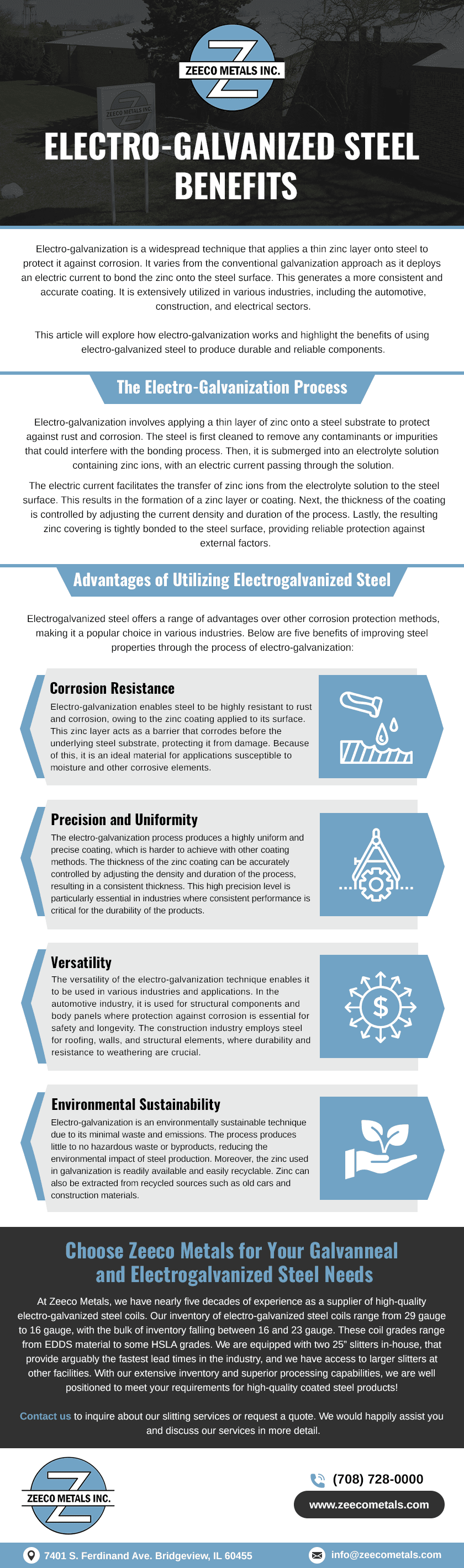
    Electro-galvanization involves applying a thin layer of zinc onto a steel substrate to protect against rust and corrosion. The steel is first cleaned to remove any contaminants or impurities that could interfere with the bonding process. Then, it is submerged into an electrolyte solution containing zinc ions, with an electric current passing through the solution.

    The electric current facilitates the transfer of zinc ions from the electrolyte solution to the steel surface. This results in the formation of a zinc layer or coating. Next, the thickness of the coating is controlled by adjusting the current density and duration of the process. Lastly, the resulting zinc covering is tightly bonded to the steel surface, providing reliable protection against external factors.

    Advantages of Utilizing Electrogalvanized Steel

    Electrogalvanized steel offers a range of advantages over other corrosion protection methods, making it a popular choice in various industries. Below are five benefits of improving steel properties through the process of electro-galvanization:

    Corrosion Resistance

    Electro-galvanization enables steel to be highly resistant to rust and corrosion, owing to the zinc coating applied to its surface. This zinc layer acts as a barrier that corrodes before the underlying steel substrate, protecting it from damage. Because of this, it is an ideal material for applications susceptible to moisture and other corrosive elements.

    Precision and Uniformity

    The electro-galvanization process produces a highly uniform and precise coating, which is harder to achieve with other coating methods. The thickness of the zinc coating can be accurately controlled by adjusting the density and duration of the process, resulting in a consistent thickness. This high precision level is particularly essential in industries where consistent performance is critical for the durability of the products.

    Versatility

    The versatility of the electro-galvanization technique enables it to be used in various industries and applications. In the automotive industry, it is used for structural components and body panels where protection against corrosion is essential for safety and longevity. The construction industry employs steel for roofing, walls, and structural elements, where durability and resistance to weathering are crucial.

    Environmental Sustainability

    Electro-galvanization is an environmentally sustainable technique due to its minimal waste and emissions. The process produces little to no hazardous waste or byproducts, reducing the environmental impact of steel production. Moreover, the zinc used in galvanization is readily available and easily recyclable. Zinc can also be extracted from recycled sources such as old cars and construction materials.

    Choose Zeeco Metals for Your Galvanneal and Electrogalvanized Steel Needs

    At Zeeco Metals, we have nearly five decades of experience as a supplier of high-quality electro-galvanized steel coils. Our inventory of electro-galvanized steel coils range from 29 gauge to 16 gauge, with the bulk of inventory falling between 16 and 23 gauge. These coil grades range from EDDS material to some HSLA grades.
    We are equipped with two 25” slitters in-house, that provide arguably the fastest lead times in the industry, and we have access to larger slitters at other facilities. With our extensive inventory and superior processing capabilities, we are well positioned to meet your requirements for high-quality coated steel products!

    Contact us to inquire about our slitting services or request a quote. We would happily assist you and discuss our services in more detail.